Hydrogen as a fuel
When people talk publicly about hydrogen-powered vehicles, trains or ships, they are usually referring to fuel cell technology. In an electrochemical process across a membrane, electricity is generated from hydrogen and oxygen. The electricity charges a battery, which in turn powers an electric motor. As the ‘combustion’ is cold, the exhaust consists of pure water vapour; no nitrogen oxides (NOx) are produced that need to be filtered out afterwards. However, fuel cells are expensive to purchase and operate. This is because a vehicle must either be built from scratch with a fuel cell powertrain or the engine and fuel tank must be completely converted for fuel cell operation. Furthermore, fuel cells require expensive, high-purity hydrogen to operate.
Direct hydrogen injection
Hydrogen direct injection, on the other hand, utilises the operating principle of the internal combustion engine. In this process, the hydrogen is injected directly into the cylinder of the engine, just like conventional fuel. The subsequent ignition of the hydrogen-air mixture and the explosive expansion within the piston chamber cause the piston to move. It is this movement that is used to power the vehicle. In this case, too, the exhaust consists mainly of water vapour. However, as this is a high-temperature combustion process, nitrogen oxides (NOx) are also produced, which must be reduced by an exhaust after-treatment system.
The aim is that diesel engines will one day be able to be converted so that, thanks to a modified injection system and without the need for other costly modifications, they can run on hydrogen.
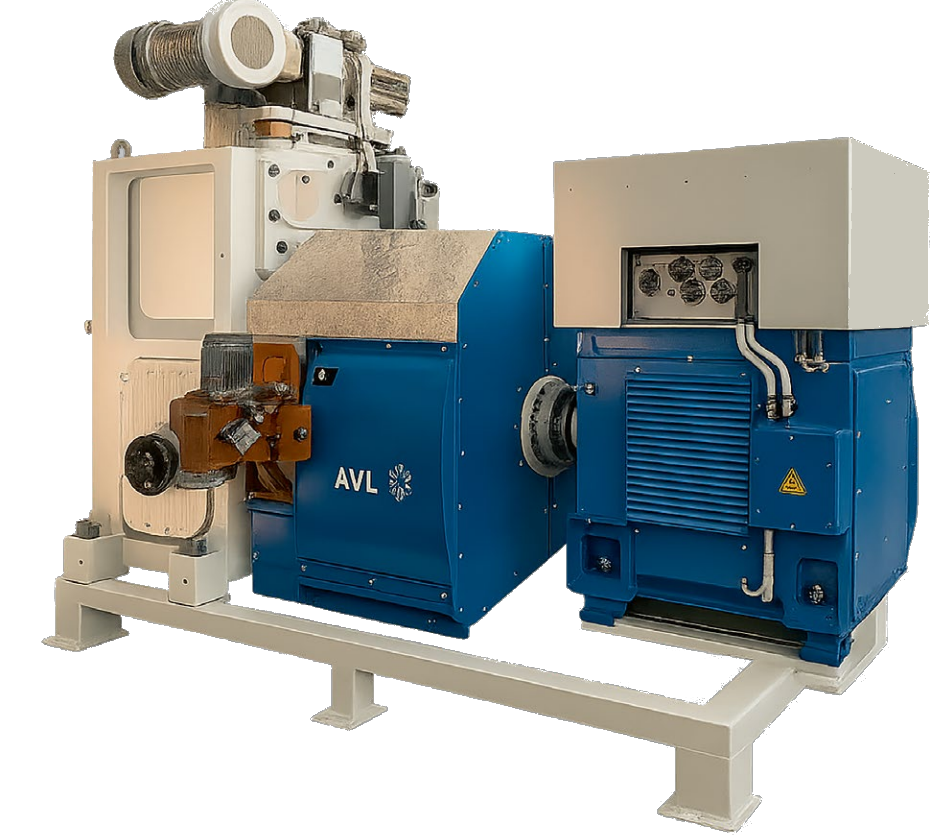
Hydrogen direct injection has been showing promising operational and performance results in large marine engines for the past two years, but is still under development. This raises the question: given the ever-more pressing need to reduce Green House Gas (GHG) emissions, why is the switch to hydrogen propulsion not already taking place today? This is not easily achievable due to various very specific properties of hydrogen:
- Complex injection
- The need for a specialised ignition system
- High stress on materials
- Complex storage requirements
- Lack of availability
Good way of injecting hydrogen is key
The DUAP engineers have opted for the ‘injection’ of gaseous hydrogen. We explain the reason for this a little further down. If the hydrogen is stored in liquid form – and is therefore cold – the gas must be vaporised into hydrogen gas in a vaporiser before injection. As it is now less dense, the hydrogen gas must be fed into the combustion chamber very quickly in order to achieve the homogeneous gas mixture required for ignition. This required lengthy and complex testing and CFD simulations using various injector designs. It has been shown that central injection with a concentrated jet pattern enables uniform and rapid mixing with air. This is of great importance for optimal ignition without fuel deposits and the associated localised overheating, leaks and excessive nitrogen oxide (NOx) formation.
A special ignition system is required
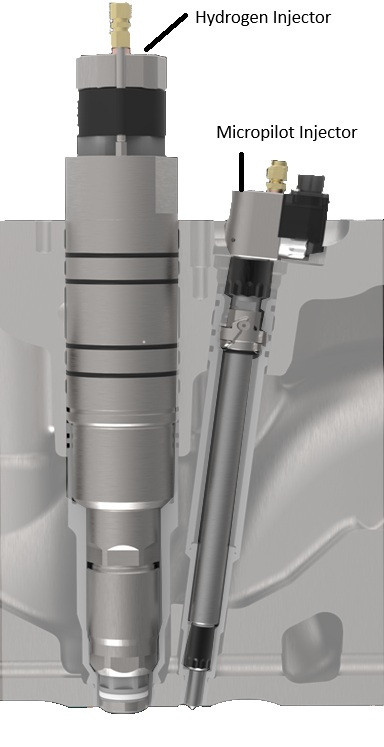
The hydrogen–air mixture is ignited by a small amount of simultaneously injected, finely dispersed diesel fuel (0.5–1.0%). Diesel and biodiesel are self-igniting and act as a kind of ignition spark – a so-called ‘micropilot’. In addition to the main injector, which injects hydrogen into the cylinder, the micro-pilot requires a second injector: the micro-pilot injector. This is a common-rail diesel injector which is positioned slightly diagonally alongside the centrally mounted hydrogen injector, also in the centre of the cylinder head.
Extremely high material stress
There has also been much debate over whether hydrogen should be injected into the cylinder in liquid or gaseous form to achieve the best results. If injected as a liquid, the gas enters a combustion chamber that is still hot from the previous ignition, with a temperature of –253°C, close to absolute zero. Ignition briefly heats the mixture to over 2000°C. This cycle from extremely hot to extremely cold is repeated several hundred times per minute. It goes without saying that this places extreme demands on the materials used in the injection system, cylinder, cylinder head, valves and pistons.
Furthermore, hydrogen is a chemically highly reactive gas which causes hydrogen embrittlement on the hot surfaces of the engine. These effects cause the nozzle, piston and cylinder materials to become brittle and crack, leading to wear.
Hydrogen storage remains an unresolved problem
The diesel and heavy fuel oil tank systems previously used are unsuitable for conversion to hydrogen operation. Under normal pressure conditions, hydrogen can only be stored in liquid form at the temperature close to absoulte zero. If hydrogen is to be stored at ambient temperature, tanks capable of withstanding pressures in excess of 700 bar are required. Gas loss during storage is unavoidable at this pressure level. Tanks capable of withstanding such extreme conditions (extreme cold or extremely high pressures) are complex to manufacture and consequently expensive. If hydrogen is to be stored in gaseous form at a moderate pressure of 20–30 bar, the required tank volume is so large that it significantly impinges on a ship’s cargo hold.
Too little, too expensive
Another obstacle to the widespread use of hydrogen as a fuel is its limited availability. Whilst there are a large number of different methods for producing hydrogen, most of them are not sustainable and, overall, generate as much or even more GHG as would be produced if fossil fuels were used. I will discuss the various methods of hydrogen production and the promising new approaches available in a later article. Natural hydrogen, which is also found in the Earth’s crust, represents a potential that has yet to be exploited. The hydrogen available today is largely absorbed by industry, for example for the refining of crude oil. Due to the limited quantities available, hydrogen is currently expensive and, because of its high volatility, costly to transport. It will be years before the production of hydrogen, its loss-free transport and the efficient storage of large quantities on land and on ships have become established.
Until then, the transport of people and goods by land and water will largely be powered by other fuels. Hydrogen, injected directly into internal combustion engines, will remain at the experimental stage until then. Nevertheless, these pilot applications are crucial for gaining experience and will be scaled up over the coming years, right up to ocean-going cargo ships that will sail the world’s oceans powered by hydrogen for testing purposes.
DUAP is a global leader in the development of hydrogen direct injection systems and associated micro-pilot injection systems. And as we are a relatively small Swiss SME, this promising area of development already represents an interesting and promising line of business for us today. We are continuing to pursue this field of hydrogen direct injection in large internal combustion engines with great interest, until it eventually matures to the point of widespread application.
Concept and author: Kuno Jung
Technical review: Erich Vogt
© copyright 2026, DUAP AG, Switzerland